

|
Milk Homogenizer
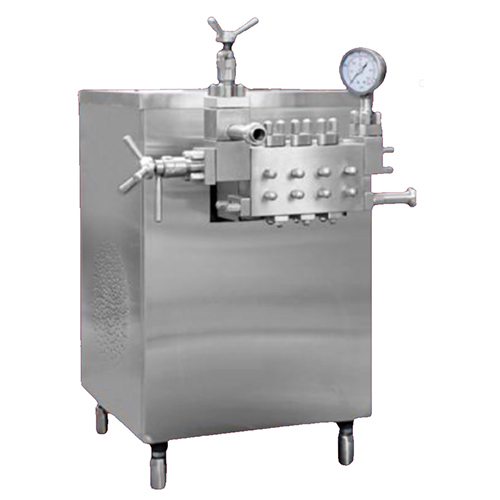

Milk Homogenizer Specification
- Product Type
- Milk Homogenizer
- General Use
- Industrial Milk Processing
- Material
- Stainless Steel
- Type
- Automatic
- Capacity
- 100-1000 Liters/Hour
- Weight (kg)
- 300-450 kg
- Computerized
- No
- Automatic
- Yes
- Control System
- PLC Control
- Processing Pressure
- 100-250 Bar
- Cleaning System
- CIP (Clean-In-Place)
- Cooling Mode
- Water Cooling
- Sterilization Method
- High-Pressure Homogenization
- Motor Power
- 7.5 - 15 kW
- Voltage
- 380V / 50Hz
- Dimension (L*W*H)
- 1200 x 650 x 1450 mm
- Feature
- Corrosion Resistance, Low Noise, Easy Operation
- Color
- Silver
- Surface Finish
- Polished
- No. of Stages
- 2 Stages
- Inlet Temperature Range
- 75C
- Installation Mode
- Floor Mounted
- Application
- Milk, Dairy, Food Industry, Beverages
- Noise Level
- 80 dB
- Outlet Size
- Customizable
- Sealing Material
- EPDM or Food-grade Rubber
- Packaging Type
- Wooden Box
Milk Homogenizer Trade Information
- Minimum Order Quantity
- 1 Piece
- Supply Ability
- 100 Pieces Per Day
- Delivery Time
- 2 Days
About Milk Homogenizer
The process of breaking up the fat globules to very small sizes in order to prevent cream formation is known as Milk Homogenizer. It is is used to break up the fat globules to below 2 micron sizes. Homogenization of milk also serves the purposes of various milk processing factories. The Milk Homogenizer offered by us can be availed from us in varied specifications at market leading price point.
Capacities - 100ltr , 200 ltr , 300 ltr , 500 ltr , 1000 ltr.
Features
MILK HOMOGENIZER
- 3 Piston and double store pressure valve
- Valves of head are starlight material
- Pressure gauge are 6000 PSI
- Counter shaft driven by electric motor
- Easy to clean and easily operate
- Milk filter and transfers pump are optional accessories
- S.S diaphragm sanitary design pressure gauge
- Suction and discharge valve also used in straight material
- Ultimate in efficient performance and versatility
Technical Specifications
|
Model |
HMG-100 |
HMG-200 |
HMG-300 |
HMG-500 |
HMG-1000 |
|
Capacity I/hr |
100 |
200 |
300 |
500 |
1000 |
|
Body |
SS-304 |
SS-304 |
SS-304 |
SS-304 |
SS-304 |
|
Electric Motor, HP |
2 HP |
3 HP |
3 HP |
5 HP |
10 HP |
|
Pressure (PSI) |
2000 |
2000 |
2000 |
2000 |
2000 |
|
Piston |
3 |
3 |
3 |
3 |
3 |
|
Stage type |
Double |
Double |
Double |
Double |
Double |
|
Valves |
Starlight |
Starlight |
Starlight |
Starlight |
Starlight |
|
Pressure Gauge |
Diaphragm |
Diaphragm |
Diaphragm |
Diaphragm |
Diaphragm |
Frequently Asked Questions
What is homogenizer in milk industry?
Homogenization is the act of dispersing a component uniformly throughout a fluid, such as milk, by breaking it down into incredibly small particles, like the fat globules in milk. The cream will not float to the top of milk that has been adequately homogenised.
What is homogenizer used for?
A homogenizer is a piece of industrial or scientific equipment used to homogenise a variety of materials, including soil, tissue, plants, food, and many more. Utilizing a variety of physical technologies, numerous models have been created for disruption.
What is homogenizer in milk industry?
Homogenization is the act of dispersing a component uniformly throughout a fluid, such as milk, by breaking it down into incredibly small particles, like the fat globules in milk. The cream will not float to the top of milk that has been adequately homogenised.
What is the pressure of milk homogenization?
Pressures of 140 bar (2000 psi) and 35 bar (500 psi) are typically maintained in the first and second stages of double-stage homogenizers, respectively. For milk with up to 6.0% fat, 140-175 bar (2000-2500 psi) pressure is typically suitable in a single-stage homogenizer.
What is the disadvantage of homogenized milk?
Your health is at risk if you drink homogenised milk. Comparatively speaking, homogenised milk has smaller particles than non-homogenized milk. Because of this, during digestion, the minute particles are directly absorbed by the circulation, harming your health. Additionally, homogenised milk has been linked to both cancer and heart disease.
Uniform Milk Homogenization Every Time
With advanced two-stage processing and high-pressure capabilities, this milk homogenizer ensures consistent, fine, and uniform dispersion of milk fat, improving product stability and taste. Suitable for various dairy and beverage applications, it enhances overall product quality and extends shelf life.
Built for Durability and Easy Operation
Constructed from stainless steel and equipped with corrosion resistance, the homogenizer is engineered to withstand rigorous industrial environments. Its PLC control system offers intuitive operation, while the noise level remains below 80 dB, ensuring a quiet workspace. Maintenance is simplified through the integrated CIP system.
Customizability and Hygienic Assurance
Outlet sizes can be customized as per processing requirements, and the machine features EPDM or food-grade rubber seals, ensuring safe and hygienic operations. The device operates at inlet temperatures up to 75C and is packed in sturdy wooden boxes for delivery and installation.
FAQ's of Milk Homogenizer:
Q: How does the two-stage homogenization process improve milk quality?
A: The two-stage homogenization process uses high pressure (100-250 bar) to break down fat globules into smaller, uniform particles, resulting in smoother texture, enhanced taste, and improved stability, which prevents cream separation and extends milk shelf life.Q: What is the recommended process for cleaning this milk homogenizer?
A: The system comes equipped with a CIP (Clean-In-Place) cleaning mechanism, allowing for effortless, automated internal cleaning without dismantling. Regular cleaning ensures hygiene standards are met, especially critical in dairy and food processing industries.Q: When should the milk homogenizer be used during milk processing?
A: The homogenizer is typically employed after pasteurization and cooling (when milk temperature is 75C) but before packaging, to ensure uniform mixing and stable end product for consumer distribution.Q: Where can this homogenizer be installed, and what are its site requirements?
A: Designed for floor mounting, the homogenizer can be set up in any dairy, beverage, or food processing facility with adequate space for its 1200 x 650 x 1450 mm dimensions and access to 380V power supply and water cooling.Q: What are the primary benefits of using PLC control in this machine?
A: The PLC (Programmable Logic Controller) system streamlines operations by providing automated controls, monitoring key parameters, and improving precision, which minimizes human errors and boosts operational efficiency.Q: How does using food-grade sealing materials like EPDM or food-grade rubber contribute to safety?
A: These material choices ensure that all contact surfaces remain non-toxic and compliant with food safety regulations, minimizing contamination risks and ensuring processed milk remains safe for consumption.Price 1100-500000 INR/ Piece
- Minimum Order Quantity
- 1 Piece
- Supply Ability
- 100 Pieces Per Day
- Delivery Time
- 2 Days
 Get Latest Price
Price:
- 50
- 100
- 200
- 250
- 500
- 1000+




Contact Details
GST : 09AATPJ2894G1Z3
 Send Inquiry
 |
G.R. JAIN INDUSTRIES
All Rights Reserved.(Terms of Use) Developed and Managed by Infocom Network Private Limited. |
